The beginner's path, in six chapters
No snobbery, no minimum spend. Read them in order, or strike a match and skip to what you need tonight. Every chapter is here in full, with illustrations.
Anatomy of a cigar
Jump to chapter →Reading the wrapper
Jump to chapter →Cut & light
Jump to chapter →The draw & the ash
Jump to chapter →Rest & storage
Jump to chapter →Pairings & ritual
Jump to chapter →Roughly half an hour to read the whole path. The glossary is at the bottom.
Anatomy of a cigar
Almost every word you'll hear in a cigar shop is the name of a part of the cigar. Learn six of them and the rest of the vocabulary falls into place.
Start at the two ends. The head is the closed, rounded end you put to your lips; the small piece of leaf sealing it is the cap. The foot is the open end you light. When someone says to "toast the foot," that's the end they mean.
Now work from the outside in. The wrapper is the outer leaf — the part you see and the part chosen for looks and flavor. It carries roughly a third of what you taste, which is why so much fuss is made over its color and condition. Beneath it, the binder is a sturdier leaf that holds everything together. At the core, the filler is the blend of leaves that sets most of the strength and flavor. Filler can be long (full leaves running the length of the cigar, the mark of a premium handmade) or short (chopped scraps, typical of machine-made cigars).
The paper ring near the head is the band — the maker's name-tag. You can slide it off or leave it on; many people wait until the cigar warms and the band loosens, so the wrapper doesn't tear.
Shape and size
A cigar's silhouette is its vitola, and its thickness is the ring gauge, measured in 64ths of an inch — so a 50 ring gauge is fifty sixty-fourths across. A thicker cigar holds more filler and usually burns cooler and slower; a thinner one puts more wrapper against your palate. None of it is better or worse, just different. Knowing the parts is enough to walk into any shop and ask a good question.
Long filler, short filler, and how it's built
In a premium handmade cigar, a roller called a torcedor gathers whole filler leaves into a bunch, wraps the binder around it, and often rests the bunch in a wooden mold to set its shape. Only then is the wrapper — the most delicate leaf — rolled on and the cap applied. Machine-made cigars usually use short, chopped filler and sometimes a homogenized binder; they burn faster and hotter, and the ash tends to fall early.
Inside the filler, leaves from different parts of the plant play different roles. Ligero, from the top, is thick and strong and burns slowly. Seco, from the middle, brings aroma. Volado, from the bottom, is thin and mild and helps the cigar stay lit. Blenders balance all three — which is why strength lives in the filler, not the wrapper.
For the illustrated version, see Anatomy.
Reading the wrapper
The wrapper is the first thing you read on a cigar, and the most misread. Its color runs along a scale from pale gold to nearly black: Claro, Colorado Claro, Colorado, Colorado Maduro, Maduro, and Oscuro.
That color comes from two things: how the leaf was grown, and how long it was fermented. Leaves grown under cloth (shade-grown, like Connecticut Shade) stay pale and mild. Leaves left in the sun grow thicker and darker. Then fermentation — a slow, controlled heating of stacked leaves — draws out sugars and deepens the color. The longer the ferment, the darker and sweeter the wrapper tends to taste.
The myth worth unlearning
Here is the thing nearly every beginner gets backwards: darker does not mean stronger. A jet-black Maduro often tastes sweeter and rounder — think cocoa and espresso — not more powerful. A cigar's strength, the nicotine punch you feel, is set mostly by the filler tobaccos hidden inside, not by the shade of the leaf on the outside. Plenty of dark cigars are mellow; plenty of light ones will knock you back.
So how should color guide a first pick? Use it for flavor, not force. If you like cream, cedar, and a light touch, start pale. If you're drawn to chocolate, coffee, and sweetness, reach for a Maduro. And ask the shop two separate questions — "how strong is it?" and "what does it taste like?" — because the wrapper only answers the second one.
A quick color-to-flavor cheat sheet
- Pale (Claro): cream, cedar, nuts, hay.
- Middle (Colorado): cedar, leather, baking spice, a touch of sweetness.
- Dark (Maduro, Oscuro): cocoa, espresso, molasses, dried fruit, earth.
Also look at the leaf itself. A good wrapper has an even color, a faint oily sheen, and veins that lie flat. Gently squeeze the cigar: it should give slightly and spring back, with no hard knots or soft, empty spots. The full scale lives on Wrapper shades.
Cut & light
Two small rituals stand between you and a good smoke: the cut and the light. Rushed, they ruin a fine cigar; done with a little care, they set up everything that follows.
The cut
You're opening the head so air can pass through. There are three common tools. A straight (guillotine) cut takes off the top of the cap for a wide, open draw — the safe default. A V-cut (or cat's-eye) presses a wedge into the cap, concentrating the smoke. A punch bores a small round hole, good for thicker cigars and travel.
Wherever you cut, the rule is the same: cut less than you think. Take only the very top of the cap, just above the shoulder where the rounded head starts to straighten. Cut too deep and the wrapper loses its anchor and unravels as you smoke.
The light
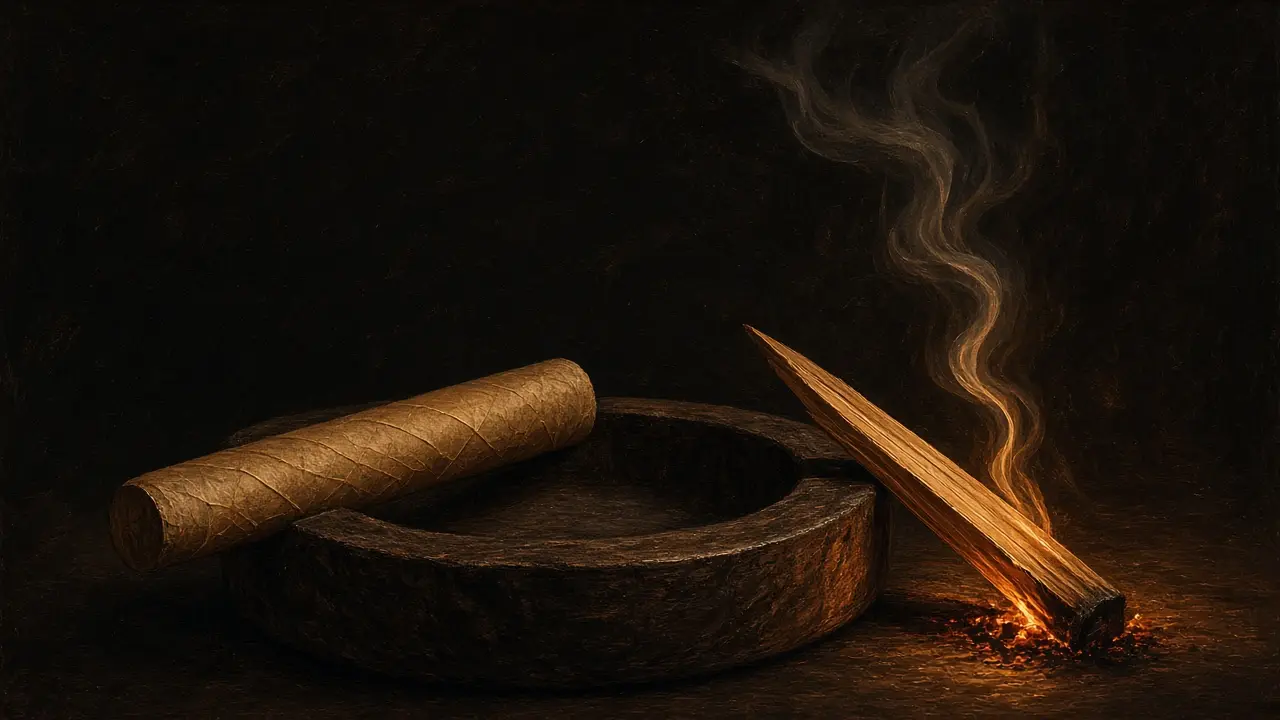
Use a clean flame: a butane lighter or a plain wooden match — or, in the old tradition, a thin strip of cedar called a spill, lit first and then carried to the cigar. Avoid candles and fuel lighters; their fumes taint the first few puffs.
Now toast the foot. Hold the cigar above the flame, not in it, and rotate it until the edge glows evenly all the way around — like toasting a marshmallow you don't want to burn. Only then put it to your lips and draw gently while you finish lighting. Take your time; a patient, even light is the whole point. The two classic mistakes are cutting too much and lighting too fast — avoid both and you're most of the way there.
Torch or soft flame?
A torch lighter is reliable outdoors but very hot, so it's easy to char the foot; hold it further away than feels natural. A soft-flame butane lighter or a long wooden match is gentler. If you use a match, let the sulfur burn off before it goes near the cigar. A cedar spill is the slowest and most fragrant of all.
If it draws badly
A tight draw usually means the cut was too shallow — take another sliver off the cap. A cigar that's very loose and burns hot was likely cut too deep or is a little dry. Don't squeeze or roll a plugged cigar hard; you'll crack the wrapper.
The draw & the ash
A cigar isn't inhaled like a cigarette. You draw the smoke into your mouth, taste it, and let it go. The pleasure is in the flavor and the pace, not the lungful.
Pace
Go slow — roughly a gentle puff a minute. Smoke too fast and the cigar overheats, turning the flavor hot, bitter, and harsh. If it starts tasting acrid, you're rushing; set it down for a minute and let it cool. A cigar is built to last an hour or more, and it rewards patience.
The retrohale
Once you're comfortable, try a retrohale: take a mouthful of smoke and let a little drift out through your nose. Your sense of smell does most of the work of tasting, so this is where the cedar, spice, coffee, and sweetness really open up. Start with the smallest amount — it's intense at first — and build from there.
Reading the ash
The ash tells you about construction. A firm, pale grey-to-white ash that holds together is the sign of well-grown tobacco and a careful roll; let it grow to about an inch before tapping it gently into a tray. A cigar that flakes or burns jet-black is often being smoked too hot. If one side burns faster than the other, that's a canoe — touch up the lagging edge with your flame. Relighting a cigar that's gone out is completely normal: knock off the ash, toast the foot again, and carry on. When it gets too short and warm to enjoy — the nub — simply set it down. You don't stub a cigar out; you just let it go.
A few signs you're doing it right
- The smoke is cool and flavorful, not hot or stinging.
- The burn line is reasonably even all the way around.
- The cigar changes as it goes — many people describe it in thirds, with flavors developing from the first third to the last.
And if you start to feel light-headed or queasy, that's nicotine. Set the cigar down, drink some water, and eat something with sugar in it. Next time, pick something milder and smoke it after a meal.
Rest & storage
Cigars are agricultural — dried leaf that wants to be kept at the right humidity. Too dry and they smoke hot and brittle; too damp and they draw poorly and risk mold. The target most people aim for is about 65–70% relative humidity at roughly 65–70°F.
The humidor
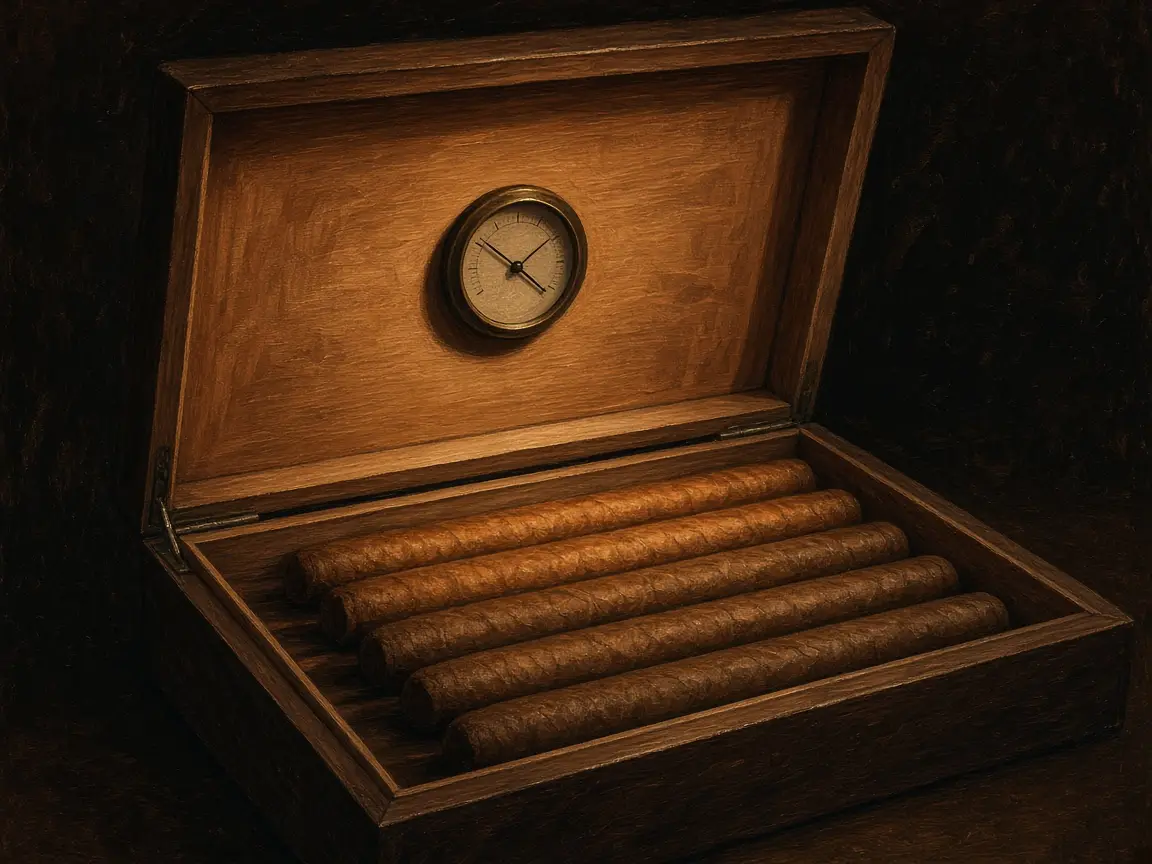
A humidor is a sealed box, usually lined with Spanish cedar, that holds that climate steady. The cedar does double duty: it buffers humidity and adds a faint sweetness over time. A new humidor must be seasoned before it ever holds a cigar — the dry wood will otherwise rob your cigars of moisture. Wipe or set distilled water inside, or use a seasoning pack, and let it sit a couple of weeks until it holds humidity on its own.
Inside, keep a hygrometer to read the humidity, and a humidification source. Many people now use pre-calibrated humidity packs (a popular brand is Boveda), which hold a set level with almost no fuss. Don't overcrowd the box — air should move around the cigars — and rotate them occasionally so they age evenly. No humidor yet? A sealed plastic tub with a humidity pack works fine for weeks.
Plume vs. mold
Over time a well-aged cigar may develop plume (sometimes called bloom): a fine, dusty white powder of crystallized oils. It's harmless and a good sign — brush it off and smoke away. Mold is the one to fear: it's fuzzy rather than powdery, often blue-green, sometimes raised, and carries a musty smell. Mold means too much moisture; affected cigars should be thrown out and the humidor wiped down and re-seasoned. The simple tell — powdery and white wipes away; fuzzy and colored does not — will save you every time.
Calibrate your hygrometer
Cheap analog hygrometers can be off by several points. A simple check: seal the hygrometer in a bag with a calibration pack, or with a capful of table salt dampened into a moist paste (not dissolved), for about a day. Salt holds the air at roughly 75% relative humidity; note the difference and adjust in your head, or reset the dial if it allows.
Use distilled water
If your humidifier takes water, use distilled water or a propylene-glycol humidor solution — tap water leaves minerals that clog the element and can encourage mold.
Pairings & ritual
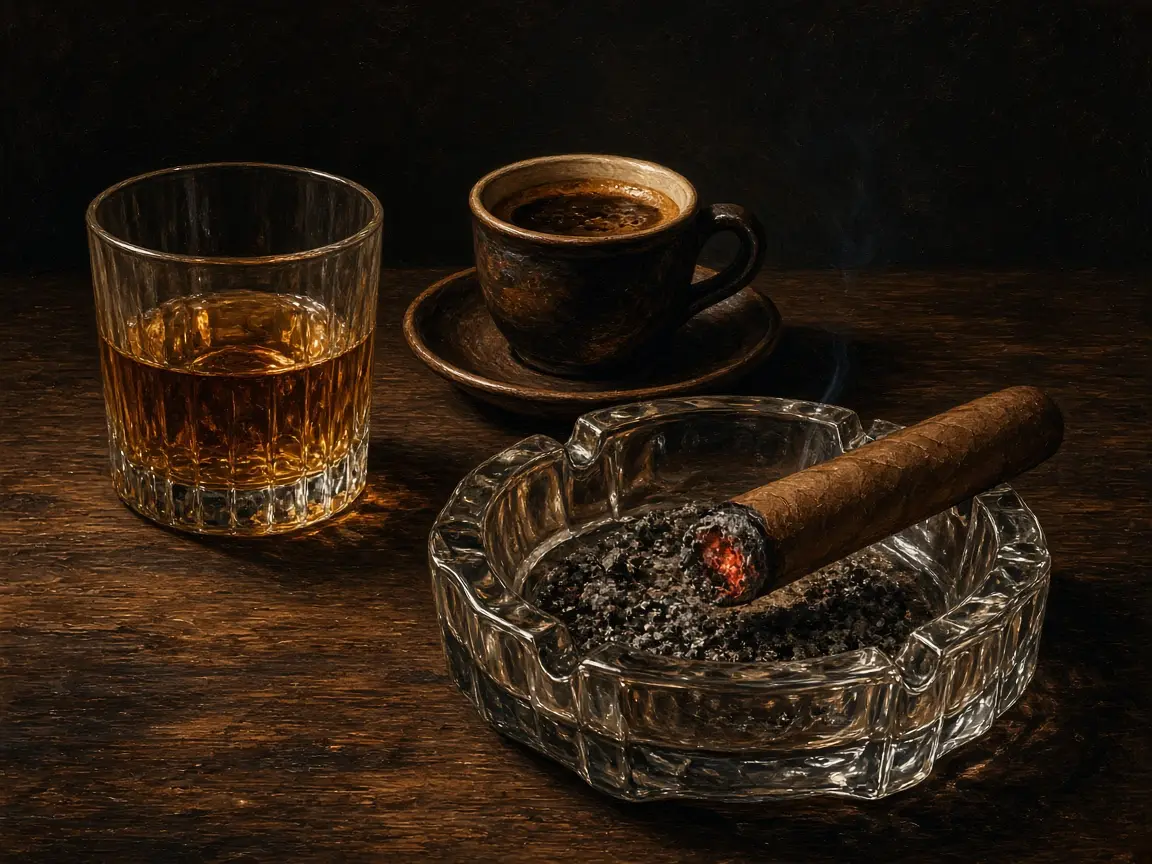
A drink can lift a cigar and a cigar can lift a drink. There's no rulebook, but there is one reliable principle: match the intensity. A delicate cigar gets drowned by a peaty Scotch; a powerhouse smoke flattens a light coffee. Pair like with like, then decide whether you want the drink to echo the cigar's flavors or contrast them.
A few that work
- Coffee & espresso — the classic, and the easiest. Roasty against roasty, all day long.
- Bourbon & rye — sweet, oaky, and a little spicy; they meet a medium-to-full cigar beautifully.
- Aged rum — its caramel and dried-fruit sweetness flatters cocoa-forward Maduros.
- Scotch — save the smoky, peaty bottles for your boldest cigars only.
- Port & sweet wines — a dessert pairing that suits a rich after-dinner smoke.
- Water — never underrated. It resets the palate and keeps you tasting clearly.
The ritual is the point
More than any single pairing, what a cigar asks of you is time. It's an hour you can't rush — no scrolling, no multitasking, just the smoke, the drink, and maybe good company. Pick a comfortable spot, light it slowly, and let the pace of the cigar set the pace of the evening. That unhurried hour, as much as the tobacco, is what people come back for.
Easy places to start
Not sure what to pour? Try a mild Connecticut-wrapped cigar with your morning coffee, a medium cigar with an amber ale or a wheated bourbon, and a sweet, dark maduro with port or an aged rum after dinner. Then swap one thing at a time and note what changes. Non-drinkers lose nothing: cola, sparkling water with citrus, black tea, and hot chocolate all have their fans.
A pocket glossary
Twelve words that turn up everywhere — starting with the one on our masthead. More words are added as new issues go up every week.
- Spill our namesake
- A thin strip of cedar you light from a flame, then use to toast the cigar's foot — a clean light with none of the taste a lighter can leave behind.
- Vitola vee-TOH-lah
- A cigar's shape and size — its silhouette. A robusto and a churchill are different vitolas of the same blend.
- Ring gauge
- The thickness, measured in 64ths of an inch. A 50 ring gauge is fifty sixty-fourths across.
- Retrohale REH-tro-hale
- Gently pushing smoke out through your nose to taste aromas the tongue alone can't reach. Go easy at first.
- Plume
- A fine, harmless white dusting of crystallized oils on a well-aged cigar — a good sign. Not to be confused with fuzzy mold.
- Vega VEH-gah
- The tobacco field or farm where the leaf is grown. Soil and shade here shape everything that follows.
- Ligero lee-HEH-roh
- Thick, oily leaves from the top of the plant. The strongest and slowest-burning filler — the main source of a blend's punch.
- Torcedor tor-seh-DOR
- A cigar roller. In premium factories, rollers often work in pairs: one bunches, one wraps.
- Puro
- A cigar whose wrapper, binder and filler all come from a single country.
- Figurado
- Any shaped cigar that isn't a straight cylinder — torpedos, belicosos, perfectos.
- Box-pressed
- Pressed into a rounded square while resting, either by packing tightly in a box or in a press.
- Canoe
- An uneven burn where one side runs ahead. Touch up the lagging side with your flame.